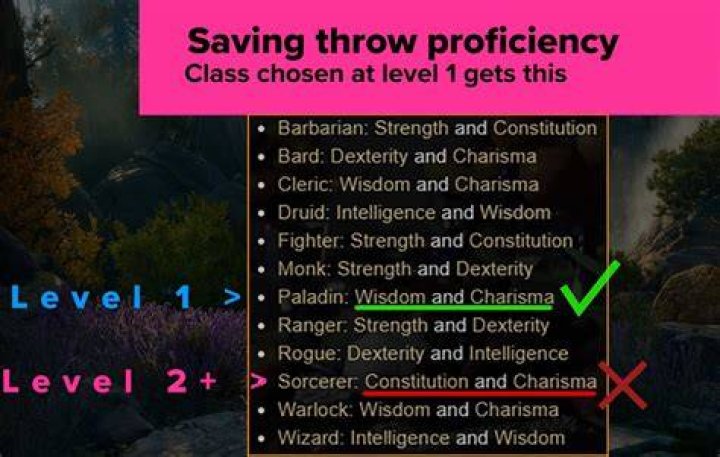
Multiclassing does not grant any saves proficiency, this is most likely due to players would multiclass into 3 classes to have all saving throws be proficient. you have to use a feat to gain anymore saving throw proficiencies..
Keeping this in consideration, do you get skill proficiency when Multiclassing?
1 Answer. No. The multiclassing rules address this point specifically: When you gain a level in a class other than your first, you gain only some of that class's starting proficiencies, as shown in the Multiclassing Proficiencies table.
Furthermore, how does proficiency bonus work with Multiclassing? Your proficiency bonus is always based on your total character level, not your level in a particular class. For example, if you are a fighter 3/rogue 2, you have the proficiency bonus of a 5th-level character, which is +3.
Regarding this, do you add proficiency to saving throws?
To make a saving throw, roll a d20 and add the appropriate ability modifier. For example, you use your Dexterity modifier for a Dexterity saving throw. As with skill proficiencies, proficiency in a saving throw lets a character add his or her proficiency bonus to saving throws made using a particular ability score.
How do you get advantage on saving throws 5e?
The easiest way to gain advantage on a death saving throw is to use inspiration. If you have inspiration, you can expend it when you make an attack roll, saving throw, or ability check. Spending your inspiration gives you advantage on that roll. Alternatively, you could be a Wild Magic Sorcerer, and use Tides of Chaos.
Related Question Answers
Can you have two classes in D&D?
If you were playing the 1974 Men & Magic D&D, the answer is likely no. For most editions of D&D, the ability to play two classes at the same time had some really convoluted rules.How do you multiclass into a wizard?
Multiclassing into Wizard - They have to purchase (or "acquire") a spell book (50g) and an arcane focus (5-20g) or component pouch (25g) before they are able to cast wizard spells.
- They have to copy their six 1st-level spells into the spell book (1 hour per spell, no gold cost) into their spell book before they are able to prepare wizard spells.
How does Multiclassing work with spells?
Readied spells work one way, spell slots work another way: To determine which spells you are able to cast, take each class separately; you know and/or can prepare spells of that class as if you were a completely single-classed character of that class of a character level equal to the level you have in that class.How do you calculate passive perception?
Passive Perception.To determine whether such a creature notices you, the GM compares your Dexterity (Stealth) check with that creature's passive Wisdom (Perception) score, which equals 10 + the creature's Wisdom modifier, as well as any other bonuses or penalties. If the creature has advantage, add 5.Can you multiclass the same class?
Multiclassing is designed solely for taking different classes. For example, you can be a fighter/rogue, but not a rogue/rogue. That said, I would talk to your DM. It may be reasonable, for example, to mix and match some of the domain powers at their discretion.When should I multiclass 5e?
Rule Two: Don't multiclass until after level 5. Characters gain a big jump in power with their fifth level features, with casters gaining third level spells, and martials gaining Extra Attack. Delaying access to these is almost always a bad idea. Rule Three: Imbalance is better.Do Cantrips scale with character level?
Cantrips scale with character level. For example, a barbarian 2 / cleric 3 casts sacred flame as a 5th-level character. on your turn? If you cast a spell, such as healing word, with a bonus action, you can cast another spell with your action, but that other spell must be a cantrip.When should you make a saving throw?
Saving ThrowsGenerally, when you are subject to an unusual or magical attack, you get a saving throw to avoid or reduce the effect. Like an attack roll, a saving throw is a d20 roll plus a bonus based on your class, level, and an ability score. Your saving throw modifier is: Base save bonus + ability modifier.Do saving throws count as ability checks?
So while saving throws and attack rolls are based on your ability scores, they are not ability checks.What is passive wisdom?
The Rulebook says that a passive wisdom (percep) score is "10 + the creature's wisdom modifier, as well as any bonuses." In the example they have a 1st-level character (with a proficiency bonus of +2) Wisdom of 15 (+2) and a proficiency in Perception, he or she has a passive Wisdom (Perception) of 14 (10+2+2).Will saving throw 5e?
Your Will save is a Saving Throw that details how well you are able to withstand mental effects. If you were targeted by a Hold Person or being charmed by a siren then you would roll a Will save against a specific DC or Difficulty Class to see if you are able to withstand the effect. Saving throws.How do Constitution saving throws work?
The save is a constitution save, so your target must roll a d20 and add their con modifier to that. If their roll + modifier is the same or higher than your spell save DC, then the spell has been surpassed and the effects do not work. For some spells, like fireball, the save is only for half damage.What is a wisdom saving throw?
A saving throw is a roll you make to resist some effect that is being used against you, generally speaking. So you would make a Dexterity saving throw to dodge out of the way of a dragon's breath, a Wisdom saving throw to negate an enchantment, or a Constitution saving throw to resist a poison, etc.What are saving throws Kotor?
Saving throws are used to determine whether a character is affected by a Force Power or the special effect of an attack or grenade. Saving throws are deceivingly unimportant in KOTOR.How do I use my proficiency bonus?
On your character sheet, if you are a first level character simply fill in s +2 in the space for "Proficiency Bonus." Then check the "Perception" skill and put +2 in the space next to it, to remind you to add that bonus when you make rolls for Pperception.How do you get a proficiency bonus?
Proficiency Bonus Your proficiency bonus is always based on your total character level, not your level in a particular class. For example, if you are a fighter 3/rogue 2, you have the proficiency bonus of a 5th-level character, which is +3. You gain a +1 bonus to AC while you wear this armor.What does proficiency bonus mean?
Proficiency bonus. A proficiency bonus is calculated for each character based on their level: it is +2 for level 1 characters. It applies to many different things including. attack rolls using weapons your character is proficient in. attack rolls using spells that your character casts.How do you determine initiative?
Determine initiative modifier.Your character's initiative modifier equals your Dexterity modifier plus any modifiers from class, race, or other features. Once you have worked out your initiative modifier, note it on your character sheet.What happens when you level up DND?
Each time you gain a level, you gain 1 additional Hit Die. Alternatively, you can use the fixed value shown in your class entry, which is the average result of the die roll (rounded up). When your Constitution modifier increases by 1, your hit point maximum increases by 1 for each level you have attained. 
 Sophia Aguilar