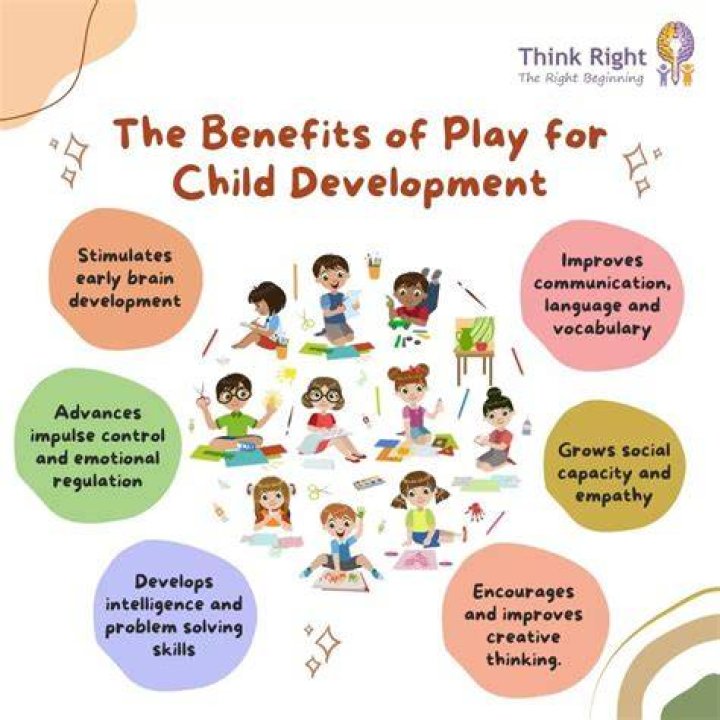
What are the benefits of intellectual play?
 Mia Russell
 .
Likewise, people ask, why is play important for intellectual development?
Play allows children to use their creativity while developing their imagination, dexterity, and physical, cognitive, and emotional strength. Play is important to healthy brain development. It is through play that children at a very early age engage and interact in the world around them.
One may also ask, what are the benefits of solitary play? Benefits of solitary play
- Fosters independence. When your child is a newborn, you do everything for them — even hand them a toy.
- Helps develop preferences and interests.
- Develops creativity and imagination.
- Develops powers of concentration, persistence, and completion.
Similarly, what is intellectual play?
Intellectual development is all about learning. Physical development – through the senses by touching, tasting, listening and playing. Emotionally and socially - through playing with other children and being with people.
What are the 4 areas of intellectual development?
Children grow and develop rapidly in their first five years across the four main areas of development. These areas are motor (physical), language and communication, cognitive and social/emotional. Cognitive development means how children think, explore and figure things out.
Related Question Answers
What are cognitive activities?
Cognitive activities are mental processes through which we make sense of the world around us or get to know or experience our environment (internal and external). Examples of cognitive activities are reasoning, thinking, perceiving, decision-making, listening, observing,etc.What is intellectual development in early childhood?
Cognitive or intellectual development means the growth of a child's ability to think and reason. It's about how they organize their minds, ideas and thoughts to make sense of the world they live in. Begin to reason and argue, uses words like why and because.What are the functions of play?
Some of the more common functions of play are to facilitate physical, emotional, cognitive, social, and moral development . PHYSICAL DEVELOPMENT Play aids in developing both fine and gross motor skills . Children repeat certain body movements purely for pleasure, and these movements develop body control.How can play enhance learning?
Play helps to nurture imagination and give a child a sense of adventure. Through this, they can learn essential skills such as problem solving, working with others, sharing and much more. In turn, this helps them develop the ability to concentrate.How can I improve my child's intellectual development?
Here are 10 easy ways you can help your child's cognitive development:- Sing-a-longs. Sing songs with your child and encourage him to sing along with you.
- Identify Noises.
- Practice the Alphabet.
- Practice Counting.
- Practice Shapes and Colors.
- Offer Choices.
- Ask Questions.
- Visit Interesting Places.
What are the stages of intellectual development?
Piaget's four stages
| Stage | Age | Goal |
|---|---|---|
| Sensorimotor | Birth to 18–24 months old | Object permanence |
| Preoperational | 2 to 7 years old | Symbolic thought |
| Concrete operational | 7 to 11 years old | Operational thought |
| Formal operational | Adolescence to adulthood | Abstract concepts |
How does play help brain development?
Play is needed for healthy brain development.Childhood play stimulates the brain to make connections between nerve cells. This is what helps a child develop both gross motor skills (walking, running, jumping, coordination) and fine motor skills (writing, manipulating small tools, detailed hand work).What are intellectual skills?
Intellectual skills are defined as the methods an individual can use to evaluate or organize information and data. In the 1950s, educational psychologist Benjamin Bloom created a model of intellectual skills that defined abilities such as application, analysis and synthesis as building on basic knowledge.What are examples of intellectual abilities?
Memory, comprehension, reasoning, analyzing, and problem solving are examples of intellectual skills that companies desire for their workers.How do you develop intellectual skills?
Eight simple steps to increase your intellectual wellness- Eight simple steps to increase your intellectual wellness.
- Read for fun.
- Debate an issue with a friend, but choose the viewpoint opposite the one you hold.
- Improve your skills for studying and learning.
- Learn a foreign language.
- Play a game.
- Play a musical instrument.
- Write down your thoughts or journal frequently.
What are intellectual milestones?
Cognitive milestones represent important steps forward in a child's development. Adults often dismissed the remarkable intellectual skills of infants and very young children, but modern thinkers and researchers have discovered that babies are in fact always learning, thinking, and exploring the world around them.What is an example of emotional development?
Examples of emotional understanding and self-regulation include: accurately identifying emotions in themselves and others; managing strong emotions such as excitement, anger, frustration and distress; and. being empathic and understanding others' perspectives.What is an example of social development?
Skills like bouncing back from being teased or sitting still in a group to listen to a story are all examples of healthy social and emotional development. They involve the ability to manage feelings and impulses which are needed to grow and learn. Feeling these emotions is not wrong.What are intellectual changes?
Intellectual development refers here to the changes that occur, as a result of growth and experience, in a person's capacities for thinking, reasoning, relating, judging, conceptualizing, etc. In particular it concerns such changes in children.What are the 5 developmental areas?
The Five Areas of Development is a holistic approach to learning that strives to break down the silos in education and ensure the development of a learner in all Five areas of Development - Cerebral, Emotional, Physical, Social and Spiritual.What can affect intellectual development?
These risks include intrauterine growth restriction (IUGR), stunting, iodine deficiency, iron-deficiency anemia, malaria, lead exposure, HIV, maternal depression, and inadequate cognitive stimulation. Additionally, maternal education and breastfeeding were identified as protective factors.What is an example of unoccupied play?
Unoccupied (play) – when the child is not playing, just observing. A child may be standing in one spot or performing random movements. Onlooker play (behavior) – when the child watches others at play but does not engage in it.What are the different types of play?
There Are 6 Types of Childhood Play—How Many Does Your Kid Engage In?- Andy445/Getty Images. Unoccupied Play.
- ferrantraite/Getty Images. Solitary Play.
- Juanmonino/Getty Images. Onlooker play.
- asiseeit/Getty Images. Parallel play.
- FatCamera/Getty Images. Associative Play.
- FatCamera/Getty Images. Cooperative play.
What are the 4 types of play?
6 Types of Play Important to Your Child's Development- Unoccupied play. Share on Pinterest. Parten defined this as a child not engaged in play.
- Independent or solitary play. Share on Pinterest.
- Onlooker play. Share on Pinterest.
- Parallel play. Share on Pinterest.
- Associative play. Share on Pinterest.
- Cooperative play. Share on Pinterest.