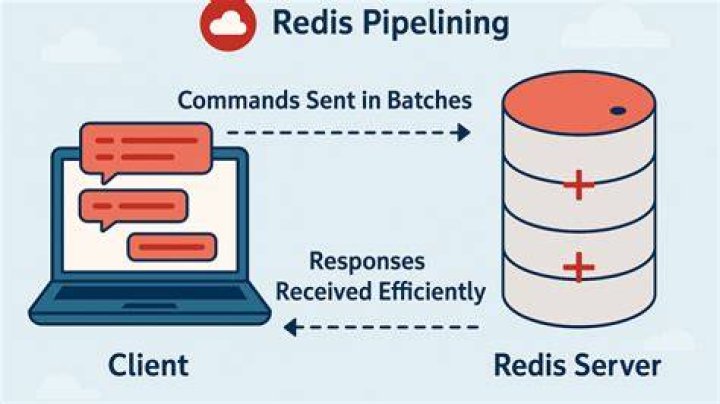
What is Redis pipelining?
 Sarah Rodriguez
 .
Likewise, people ask, which is a benefit of pipelining in Redis?
Redis offers a feature called pipelining. It allows clients to interleave the request/response cycle of several commands in such a way that first all the requests are sent and only then the client waits to receive the replies. The benefit of this technique is a drastically improved protocol performance.
Also, how fast is Redis? Without Redis, they would've needed to build a 150+ node cluster to support a network speed of 120 Gbps. In addition, they would've required increased work at the application level. Redis works using a six, in-memory, node cluster, 1.5 Gbps, and no extra work at the application level.
Simply so, is Redis pipeline Atomic?
Pipelining does not guarantee that the commands are atomic either; that's the role of transactions. Redis support transactions as a way of executing a series of commands atomically. Once a transaction is executed by a call to the EXEC command, the server will execute all the queued command sequentially and atomically.
Is Redis ACID compliant?
Redis is single threaded which allows it to be ACID compliant (Atomicity, Consistency, Isolation and Durability). Other NoSQL databases generally don't provide ACID compliance, or they provide it partially.
Related Question Answers
Is Redis single threaded?
Redis is, mostly, a single-threaded server from the POV of commands execution (actually modern versions of Redis use threads for different things). It is not designed to benefit from multiple CPU cores. People are supposed to launch several Redis instances to scale out on several cores if needed.What is Pipelining and what are the advantages of pipelining?
Advantages of PipeliningIncrease in the number of pipeline stages increases the number of instructions executed simultaneously. Faster ALU can be designed when pipelining is used. Pipelined CPU's works at higher clock frequencies than the RAM. Pipelining increases the overall performance of the CPU.Which is a difference between Memcached and Redis?
Redis and Memcached are both in-memory data storage systems. Memcached is a high-performance distributed memory cache service, and Redis is an open-source key-value store. Similar to Memcached, Redis stores most of the data in the memory. In this article, we will examine the difference between Redis and Memcached.Which is the default persistence mode in Redis?
Snapshotting. As previously stated, snapshotting is the default persistence mode for Redis. It asynchronously performs a full dump of your database to disk, overwriting the previous dump only if successful. Therefore, the latest dump should always be in your dbfilename location.Which configuration setting is used to specify the memory eviction policy in Redis?
In order to specify the memory eviction policy in Redis the maxmemory configuration. directive is used so as in the data set a specified amount of memory can be used. During run time configuration set can be used to set the configuration directive. Max memory can be set to zero and hence can result in no memory limit.Which file is configured to change persistence mode in Redis?
CONFIG SET parameter valueThe CONFIG SET command is used in order to reconfigure the server at run time without the need to restart Redis. You can change both trivial parameters or switch from one to another persistence option using this command.What is Redis server?
Redis is an open source (BSD licensed), in-memory data structure store, used as a database, cache and message broker. It supports data structures such as strings, hashes, lists, sets, sorted sets with range queries, bitmaps, hyperloglogs, geospatial indexes with radius queries and streams.Which configuration setting specifies the file to which the RDB snapshot dump is saved?
dump. rdb file is the default file in which redis will save the data to disk if you enable rdb based persistence in the redis. conf file. In this case, it is better to get it from the redis config by executing the command below.What is race condition in Redis?
Using Redis one-way gates to eliminate massively parallel high speed race conditions. Because each worker is not aware of what the other workers are doing, this often leads to race conditions when the workers try to access and modify the same centralized data stores at the same time.Is Redis faster than MongoDB?
Redis is faster at a key/value scenario if you just need to put get and put some binary data by a primary key. MongoDB is faster if you have lots of data that doesn't fit in RAM (since Redis won't even work for that). MongoDB is easier if you need to spread your data across several servers automatically.Why is Redis so fast?
The ability to work with different types of data is what really makes Redis an especially powerful tool. A key value could be just a string as is used with Memcached. All of the data is stored in RAM, so the speed of this system is phenomenal, often performing even better than Memcached.When should I use Redis?
Top 5 Redis Use Cases- Session Cache. One of the most apparent use cases for Redis is using it as a session cache.
- Full Page Cache (FPC) Outside of your basic session tokens, Redis provides a very easy FPC platform to operate in.
- Queues.
- Leaderboards/Counting.
- Pub/Sub.
- More Redis Resources.