What is the best way to revise for A levels?
 Ava Bailey
 Level Revision Tips
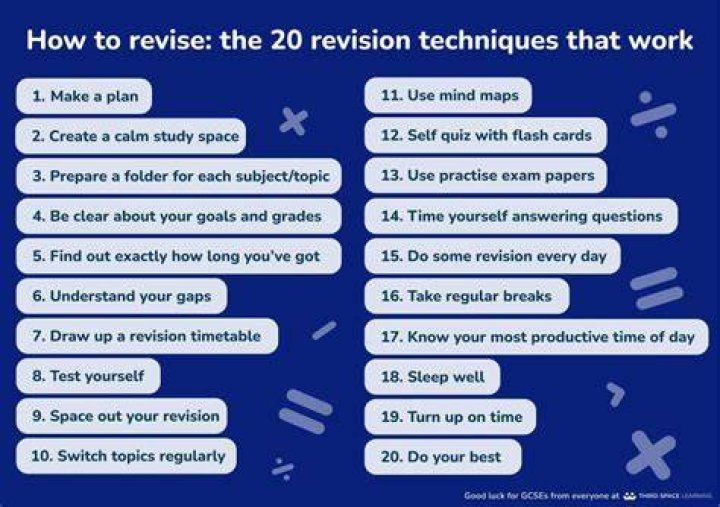
- Give Yourself Plenty of Time. Start your revision as early as you can – especially for the subjects that you find most difficult.
- Get Organised.
- Download the Specification.
- Understand the Assessment Objectives.
- Take Breaks and Get Enough Rest.
- Practice Past Exam Papers.
- Turn Off Temptation.
- You Are What You Eat.
.
Subsequently, one may also ask, how much revision should I do a day for A levels?
According to The Student Room, students revise 15 to 20 hours per week for their exams, which might sound a lot until you break it down. You've probably worked it out for yourself, but the recommended time equates to three to five hours of revision per day with weekends off!
Subsequently, question is, how do you revise for A levels in a month? How to revise for your A-levels in one month
- Step one: Prioritise. Everyone has strong subjects and weaker ones.
- Step two: Go over the exam syllabus. Spend time on this, because it's important.
- Step three: Use all the time you have.
- Step four: Actually do practice papers.
Then, when should you revise for A levels?
Planning is the key to effective revision. Reports from WhatUni agree that four to five weeks (around a month before your first exam) is the minimum time you should set yourself to revise, so if your first exam is the middle of May, you might want to start revising during or just after the Easter holidays.
How can I pass my A levels?
Revision Tips for A-levels
- Create a Revision Timetable.
- Practice Past Exam Papers.
- Collaborate with Classmates.
- Exercise Regularly.
- Figure Out Your Learning Style.
- Test Your Knowledge.
- Use Mind Maps to Connect Ideas.
- Day of Your A-level Exam.
Related Question Answers
Is it better to revise one subject a day?
Do revise more than one subject a day – Split your time between two or three subjects every day, too much focus on one subject will tire you out. E.g. do some maths revision in the morning and some chemistry revision in the afternoon.How many hours can a person study?
So for the average person the time you can concentrate with your total focus is about 90 minutes to 2 hours. But it can be trained into longer intervals. Thus your work and study tasks that require your absolute most focus can be performed for about 2-4 hours(depending on your brain capacity).How many hours for an A level?
A-levels involve 360 guided learning hours and generally take two years to complete if studied full-time alongside other courses. Guided learning hours are the number of hours of supervised or directed study time you'll need to do to for your A/AS level qualification.How do you revise for A levels in a week?
How to revise for exams in a week- Cut out the fat from your revision. You can't expect to revise all the desirable topics.
- Study with summaries.
- Whip up some flashcards.
- Familiarise yourself with past papers.
- Clear your head.
- Revise with essay plans.
- Look at mark schemes.
- The night before the exam – should I revise or sleep?
How many hours a day should you study for A levels?
Students Study an Average 15-20 Hours Per Week for their A Levels.How do you revise in one day?
Beat the exam stress with these six great tips.- Use lecture slides and past papers.
- Study without technology and social media.
- Re-read your lecture notes and highlight.
- Condense the information.
- Eat healthy brain food.
- Use memory tricks.
- Memorise some important names and dates.
- Take breaks between each topic.
How long should you study in one sitting?
The traditional rule says that you should study two hours for every hour that your class meets. In reality, every student has easy courses that require much less study time. Still, for the difficult classes, the two-for-one ratio is a good idea.Do Year 12 mocks matter?
Sure, the grades you get in your Year 12 mock exams won't count towards your final A-level grade. After all, Year 12 mocks have the potential to impact your future, whether that's your performance in your A-level exams in Year 13 or your life at university.How do you revise last minute?
TOP TEN TIPS FOR LAST MINUTE REVISION- PLAN YOUR TIME. You may already have a revision plan but as the exams draw closer it's worth working out a plan for your last minute revision.
- PRIORITISE YOUR TIME.
- START EARLY.
- GET RID OF DISTRACTIONS.
- DON'T JUST READ.
- TAKE A BREAK.
- REVISE EVERYWHERE.
- MAKE A CHEAT SHEET.
When should I start my past papers for a level?
At least two weeks before your exams, start concentrating on past papers. Do each one at least twice. With each one, trawl through the mark scheme and ensure you understand everything there. This gives you a better idea of how to think through an exam question.How do I start revising?
17 Essential Revision Tips- Start revising early.
- Plan your revision using a timetable.
- Don't spend ages making your notes look pretty.
- Set up a nice, tidy study space.
- Vary your revision with different activities.
- Stick revision notes all around your house.
- Sleep on your exam notes (optional)
- Do lots of practice papers and questions.
How do you not fail A levels?
- please don't put 'failing A-Levels' when you're not working at an E/U!
- You know what situation you're in so REVISE!
- Not getting into a 'good' uni does not equal no job.
- Take a deep breath, calm down.
- Getting BCC etc.
Which is the hardest a level?
According to SnapRevise, the hardest A-Level subjects to study are:- History.
- Physics.
- English literature.
- Chemistry.
- Maths.
- Psychology.
- Biology.
- Music. The list was based on the general opinions of students.
How do you focus when revising?
Here are a few tips to help:- Find a revision spot. Finding a place to revise is so important for prolonging concentration.
- Get a good night's sleep. Making sure you are well rested is extremely important during exams.
- Learn to turn a blind eye.
- Remove distractions.
- Make a plan.
- Allow downtime.
- Keep your blood flowing.
Why is biology a level so hard?
The reason students drop out of A-Level Biology is because it's so difficult. In conclusion, A-Level Biology is a lot more difficult than GCSE. Not only is there more content (which you have to learn on your own) the content is more difficult to understand, too.Are A levels hard?
Language A-levels are very easy for native speakers. They are hard for dyslexics. Thus, if you got an A* in GCSE Chemistry, you should not be put off by A-level Chemistry because it has a reputation for being hard.How can I study in 1 month?
You may want to give some exams more study time than others, so find a balance that you feel comfortable with.- Organize your study space.
- Use flow charts and diagrams.
- Practice on old exams.
- Explain your answers to others.
- Organize study groups with friends.
- Take regular breaks.
- Snack on brain food.
- Plan your exam day.
How do you get an A in a level law?
4 Simple Tips to Get an A* in Your Law A-Level- Tip #1: Finish (and Learn) Your Notes Early On.
- Tip #2: Be Proactive and Organised.
- Tip #3: Memorise a Good Essay Structure.
- Tip #4: Use Any Available Revision Resources.