What is the easiest way to identify prime numbers?
 Sophia Aguilar
 .
Subsequently, one may also ask, what is the easiest way to determine if a number is prime?
To prove whether a number is a primenumber, first try dividing it by 2, and see if you get a wholenumber. If you do, it can't be a prime number. If youdon't get a whole number, next try dividing it by primenumbers: 3, 5, 7, 11 (9 is divisible by 3) and so on, alwaysdividing by a prime number (see table below).
how can you tell if a number is prime or composite? To determine if a number is prime or composite, followthese steps:
- Find all factors of the number.
- If the number has only two factors, 1 and itself, then it isprime.
- If the number has more than two factors, then it iscomposite.
One may also ask, how do you figure out prime numbers?
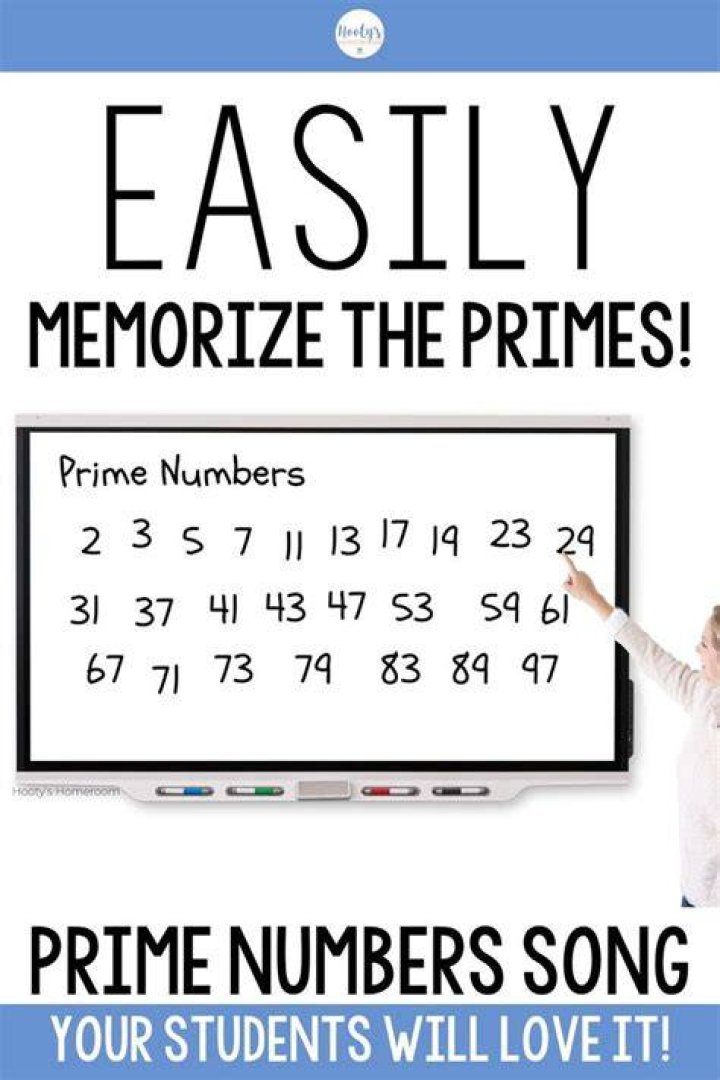
We can, therefore, determine that the numbersthat we haven't highlighted are all prime numbers. So now wehave the list of prime numbers between 1 and 100: 2, 3, 5,7, 11, 13, 17, 19, 23, 29, 31, 37, 41, 43, 47, 53, 59, 61, 67, 71,73, 79, 83, 89, and 97.
What is the definition of a prime number?
A prime number is a whole number greaterthan 1 whose only factors are 1 and itself. A factor is a wholenumbers that can be divided evenly into anothernumber. The first few prime numbers are 2, 3, 5, 7,11, 13, 17, 19, 23 and 29. Numbers that have more than twofactors are called composite numbers.
Related Question Answers
Is there a pattern to prime numbers?
Now, however, Kannan Soundararajan and Robert LemkeOliver of Stanford University in the US have discovered that whenit comes to the last digit of prime numbers, there isa kind of pattern. Apart from 2 and 5, all primenumbers have to end in 1, 3, 7 or 9 so that they can't bedivided by 2 or 5.Why is 11 not a prime number?
Prime Numbers1 itself, by definition, is not a prime number.The first few prime numbers are 2, 3, 5, 7, 11, 13,… Now 2, 3 and 7 are prime numbers and can't bedivided further. The product2 ×2 ×3× 7 is calledthe prime factorisation of 84, and 2, 3 and 7 are itsprime factors.Why 1 is not a prime number?
( One (1) is NOT a prime number because it doesnot satisfy the definition of a prime number!Examples of the prime numbers less than 20 are 2, 3, 5, 7,11, 13, 17, and 19 because the only positive integers that each ofthese numbers is divisible by are itself and 1, i.e.,exactly two positive integers.What number is a composite number?
A composite number is a positive integer which isnot prime (i.e., which has factors other than 1 and itself). Thefirst few composite numbers (sometimes called "composites"for short) are 4, 6, 8, 9, 10, 12, 14, 15, 16, (OEIS A002808),whose prime decompositions are summarized in the followingtable.How many prime numbers are there between 1 and 200?
List of prime numbers before 200: 2, 3, 5,7, 11, 13, 17, 19, 23, 29, 31, 37, 41, 43, 47, 53, 59, 61, 67, 71,73, 79, 83, 89, 97, 101, 103, 107, 109, 113, 127, 131, 137, 139,149, 151, 157, 163, 167, 173, 179, 181, 191, 193, 197,199.Is 41 a prime number?
All numbers that end in five are divisible byfive. Therefore all numbers that end with five and aregreater than five are composite numbers. The primenumbers between 2 and 100 are 2, 3, 5, 7, 11, 13, 17, 19, 23,29, 31, 37, 41, 43, 47, 53, 59, 61, 67, 71, 73, 79, 83, 89and 97.Why is 2 a prime number?
Two is a prime because it is divisible by onlytwo and one. All the other even numbers are not primebecause they are all divisible by two.Is 15 a prime number?
For 15, the answer is: No, 15 is not aprime number. To be 15 a prime number, it would havebeen required that 15 has only two divisors, i.e., itselfand 1.Is 0 a prime number?
Zero is not prime, since it has more than 2divisors. Zero is even, since 0=2⋅0, and0 is an integer. If we use "number" in essentiallyany of the usual senses (integer, real number, complexnumber), yes, zero is a number.Is 99 a prime number?
For 99, the answer is: No, 99 is not aprime number. The list of all positive divisors (i.e., thelist of all integers that divide 99) is as follows: 1, 3, 9,11, 33, 99. To be 99 a prime number, it would havebeen required that 99 has only two divisors, i.e., itselfand 1.Is 200 a prime number?
For 200, the answer is: No, 200 is not aprime number. To be 200 a prime number, it would havebeen required that 200 has only two divisors, i.e., itselfand 1. As a consequence: 200 is a multiple of1.Is 300 a prime number?
For 300, the answer is: No, 300 is not aprime number. To be 300 a prime number, it would havebeen required that 300 has only two divisors, i.e., itselfand 1.What are the prime numbers from 1 to 500?
2, 3, 5, 7, 11, 13, 17, 19, 23, 29, 31, 37, 41, 43, 47,53, 59, 61, 67, 71, 73, 79, 83, 89, 97, 101, 103, 107, 109, 113,127, 131, 137, 139, 149, 151, 157, 163, 167, 173, 179, 181, 191,193, 197, 199, 211, 223, 227, 229, 233, 239, 241, 251, 257, 263,269, 271, 277, 281, 283, 293, 307, 311, 313, 317, 331, 337, 347,349,How many prime numbers are there under 1000?
Prime NumberFor example, there are 25 prime numbersfrom 1 to 100: 2, 3, 5, 7, 11, 13, 17, 19, 23, 29, 31, 37, 41, 43,47, 53, 59, 61, 67, 71, 73, 79, 83, 89, 97.Is 65 a prime number?
To be 65 a prime number, it would have beenrequired that 65 has only two divisors, i.e., itself and 1.However, 65 is a semiprime (also called biprime or2-almost-prime), because it is the product of a twonon-necessarily distinct prime numbers. Indeed, 65 =5 x 13, where 5 and 13 are both prime numbers.How many prime numbers are there between 100 and 200?
101, 103, 107, 109, 113, 127, 131, 137, 139, 149, 151,157, 163, 167, 173, 179, 181, 191, 193, 197, 199.Is 17 a composite number?
A composite number is a number that can bedivided evenly by more numbers than 1 and itself. It is theopposite of a prime number. The number 17 can beevenly divided by 1 and 17, with no remainder. Since17 can be divided by just 1 and 17, it is not acomposite number.How do you know a number is divisible by 7?
How to Tell if a Number is Divisible by 7- Take the last digit of the number you're testing and doubleit.
- Subtract this number from the rest of the digits in theoriginal number.
- If this new number is either 0 or if it's a number that'sdivisible by 7, then you know that the original number is alsodivisible by 7.