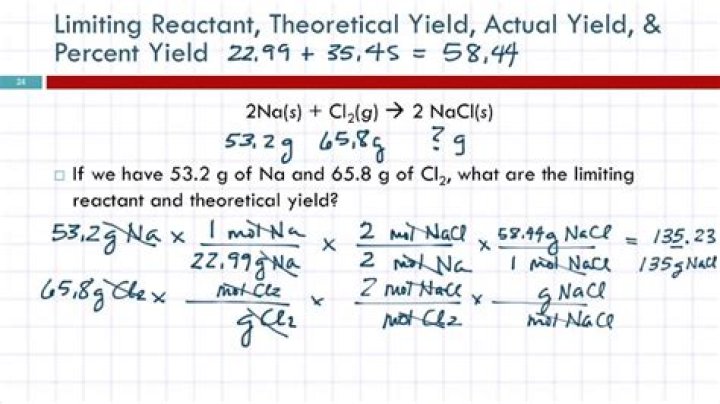
What is the percentage yield from the limiting reagent?
 Sarah Rodriguez
.
Hereof, what is limiting reactant and percent yield?
Limiting Reagents and Percentage Yield. "If onereactant is entirely used up before any of the otherreactants, then that reactant limits the maximumyield of the product." Problems of this type are done inexactly the same way as the previous examples, except that adecision is made before the ratio comparison is done
Subsequently, question is, how do you find percent yield from grams? Multiply the expected moles of the product by its molarmass. For example, the molar mass of HF is 20 grams.Therefore, if you expect 4 moles of HF, the theoreticalyield is 80 grams. Divide the actual yield ofthe product by the theoretical yield and multiply by100.
Similarly one may ask, how do you determine the limiting reactant?
Find the limiting reagent by looking at the number of molesof each reactant.
- Determine the balanced chemical equation for the chemicalreaction.
- Convert all given information into moles (most likely, throughthe use of molar mass as a conversion factor).
- Calculate the mole ratio from the given information.
What is a good percent yield?
Usually a reaction is given a maximum percentageyield; as the name suggests, this is the highestpercentage of theoretical product that can practically beobtained. A reaction yield of 90% of the theoreticalpossible would be considered excellent. 80% would be verygood. Even a yield of 50% is consideredadequate.
Related Question Answers
Is limiting reagent theoretical yield?
The theoretical yield is the amount of theproduct in g formed from the limiting reagent. From themoles of limiting reagent available, calculate the grams ofproduct that is theoretically possible (same as Step 4 above). Theactual yield is the amount of the product in g actuallyformed in the laboratory.Can the percent yield be over 100 explain?
Typically, percent yields are understandablyless than 100% because of the reasons indicated earlier.However, percent yields greater than 100% are possible ifthe measured product of the reaction contains impurities that causeits mass to be greater than it actually would be ifthe product was pure.What is a limiting reactant example?
Limiting Reactant - The reactant in achemical reaction that limits the amount of product that can beformed. The reaction will stop when all of the limitingreactant is consumed. Excess Reactant - Thereactant in a chemical reaction that remains when a reactionstops when the limiting reactant is completelyconsumed.What is the difference between actual yield and theoretical yield?
Amounts of products calculated from the completereaction of the limiting reagent are called theoreticalyields, whereas the amount actually produced of a product isthe actual yield. The ratio of actual yield totheoretical yield expressed in percentage is called thepercentage yield.What is a limiting reagent in chemistry?
The limiting reactant or limiting reagentis a reactant in a chemical reaction that determinesthe amount of product that is formed. The reason there is alimiting reactant is that elements and compounds reactaccording to the mole ratio between them in a balancedchemical equation.Why Is percent yield important in chemistry?
Percentage yield is important because:chemical reactions very often form by-products as well asthe intended product. in most reactions, not all of the reactantsactually react.What is limiting reagent Class 11?
Class 11 Chemistry Concepts of Chemistry.Limiting Reagent. Limiting Reagent. In a chemicalreaction, reactant which is present in the lesser amountgets consumed after sometime and after that no further reactiontakes place whatever be the amount of the other reactantpresent.Which of the reactants in your experiment was the limiting reagent?
The limiting reagent in both experimentswas the copper chloride. I can determine this because aftereach experiment, zinc remained, making it thereactant in excess. The copper chloride reactedcompletely with the zinc as can be seen with its color change.Therefore, the copper chloride is the limitingreagent.Why limiting reactants are important?
The limiting reagent/reactant isimportant because it can tell a chemist, that with how evermuch of this substance they use, because it is limiting thereaction, only x moles of products can form instead of thetheoretical y when the perfect amount is used.How do you calculate grams to moles?
To convert grams to moles, start bymultiplying the number of atoms by the atomic weight for eachelement in the compound. Then, add all of your answers together tofind the molar mass of the compound. Finally, divide the number ofgrams of the compound by the molar mass of the compound tofind the number of moles.How do you solve stoichiometry problems?
There are four steps in solving a stoichiometryproblem:- Write the balanced chemical equation.
- Convert the units of the given substance (A) to moles.
- Use the mole ratio to calculate the moles of wanted substance(B).
- Convert moles of the wanted substance to the desiredunits.
How do I calculate moles?
Use the molecular formula to find the molar mass;to obtain the number of moles, divide the mass of compoundby the molar mass of the compound expressed in grams.Is the limiting reagent the one with less moles?
A limiting reagent is a reactant that hasthe lowest number of moles of all reactants in the chemicalreaction and once it is completely consumed the reactionterminates. An excess reagent is a reactant that hasa higher number of moles and therefore is not used up when areaction goes to completion.What is excess reactant?
The excess reactant is the reactant in achemical reaction with a greater amount than necessary to reactcompletely with the limiting reactant. It is thereactant(s) that remain after a chemical reaction hasreached equilibrium.What is the percent error formula?
Percent Error FormulaPercent error is the difference between ameasured and known value, divided by the known value, multiplied by100%. For many applications, percent error is expressed as apositive value. The absolute value of the error is dividedby an accepted value and given as apercent.How do you find theoretical yield?
How to Calculate Theoretical Yields- Determine the number of moles of each reactant.
- Multiply the molecular weight by the number of moles in theequation.
- Calculate the theoretical mole yield by using the chemicalequation.
- Multiply the number of moles of the product by the molecularweight of the product to determine the theoretical yield.