When should I use a message broker?
 Mia Russell
 - If you want to control data feeds. For example, the number of registrations in any system.
- When the task is to send data to several applications and avoid direct use of their API.
- When you need to complete processes in a defined order, like a transactional system.
.
Keeping this in view, what is the use of message broker?
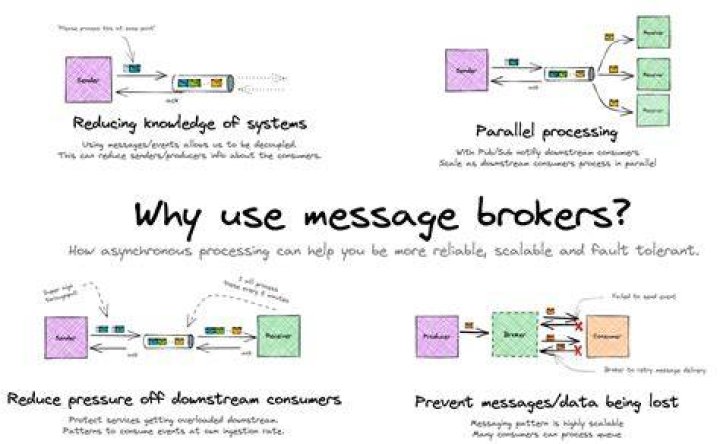
A message broker is an architectural pattern for message validation, transformation, and routing. It mediates communication among applications, minimizing the mutual awareness that applications should have of each other in order to be able to exchange messages, effectively implementing decoupling.
when should I use a message queue? Use message queues to decouple your monolithic applications. Rather than performing multiple functions within a single executable, multiple programs can exchange information by sending messages between processes, making them easier to test, debug, evolve and scale.
Besides, is Kafka a message broker?
Kafka is a message bus developed for high-ingress data replay and streams. Kafka is a durable message broker that enables applications to process, persist and re-process streamed data. Kafka has a straightforward routing approach that uses a routing key to send messages to a topic.
When should I use RabbitMQ?
I would recommend using RabbitMQ (or any message queue system of your choice) for processing tasks asynchronously or where it makes sense to decouple your application from another application or service. File transcoding.
Related Question Answers
Is Kafka a JMS?
Kafka vs JMS, SQS, RabbitMQ MessagingYes. It can be both. Kafka is like a queue for consumer groups, which we cover later. Basically, Kafka is a queue system per consumer group so it can do load balancing like JMS, RabbitMQ, etc.What is the difference between Kafka and RabbitMQ?
Publishers send messages to exchanges, and consumers retrieve messages from queues. Decoupling producers from queues via exchanges ensures that producers aren't burdened with hardcoded routing decisions. Nearly the opposite of RabbitMQ, Kafka employs a dumb broker and uses smart consumers to read its buffer.Is Kafka a message queue?
Kafka as a Messaging SystemMessaging traditionally has two models: queuing and publish-subscribe. In a queue, a pool of consumers may read from a server and each record goes to one of them; in publish-subscribe the record is broadcast to all consumers.What is difference between ActiveMQ and RabbitMQ?
The main difference between ActiveMQ and RabbitMQ is that ActiveMQ is an open-source multi-protocol supported message broker written in Java language while RabbitMQ is an open-source multi-protocol supported messaged broker written in Erlang language.Is RabbitMQ a message bus?
Last updated September 2019. RabbitMQ is a message-queueing software also known as a message broker or queue manager. It could, for example, have information about a process or task that should start on another application (which could even be on another server), or it could be just a simple text message.Why is MQ used?
It works with a broad range of computing platforms, applications, web services and communications protocols for security-rich message delivery. IBM MQ provides a communications layer for visibility and control of the flow of messages and data inside and outside your organization.How does a message bus work?
A Message Bus is a messaging infrastructure to allow different systems to communicate through a shared set of interfaces(message bus). The basic idea of a message queue is a simple one: Two (or more) processes can exchange information via access to a common system message queue.What is an event broker?
An event broker is middleware software, appliance or SaaS used to transmit events between event producers and consumers in a publish-subscribe pattern.Is Kafka a messaging system?
Apache Kafka is a distributed publish-subscribe messaging system and a robust queue that can handle a high volume of data and enables you to pass messages from one end-point to another. Kafka is suitable for both offline and online message consumption.What is Kafka messaging?
A messaging system lets you send messages between processes, applications, and servers. Apache Kafka is a software where topics can be defined (think of a topic as a category) to where applications can add, process and reprocess data (messages).Does Kafka support queues?
Using Kafka as a message queue. Apache Kafka is a very popular publish/subscribe system, which can be used to reliably process a stream of data. The central concept in Kafka is a topic, which can be replicated across a cluster providing safe data storage. It is not possible to acknowledge individual messages.Does Kafka use HTTP?
Introduction. The HTTP - Kafka bridge allows clients to communicate with an Apache Kafka cluster over the HTTP/1.1 protocol. It's possible to include a mixture of both HTTP clients and native Apache Kafka clients in the same cluster.Is Kafka free?
Kafka itself is completely free and open source. Confluent is the for profit company by the creators of Kafka. The Confluent Platform is Kafka plus various extras such as the schema registry and database connectors.Is Kafka streaming?
Kafka Streams is a client library for building applications and microservices, where the input and output data are stored in Kafka clusters. It combines the simplicity of writing and deploying standard Java and Scala applications on the client side with the benefits of Kafka's server-side cluster technology.Is Kafka a data store?
The answer is no, there's nothing crazy about storing data in Kafka: it works well for this because it was designed to do it. Data in Kafka is persisted to disk, checksummed, and replicated for fault tolerance. Because messaging systems scale poorly as data accumulates beyond what fits in memory.What is Kafka queue?
Apache Kafka is a community distributed event streaming platform capable of handling trillions of events a day. Initially conceived as a messaging queue, Kafka is based on an abstraction of a distributed commit log.How much does Kafka cost?
As with all things AWS, the pricing is a bit complicated, but a basic Kafka instance will start at $0.21 per hour. You're not likely to just use one instance, so for a somewhat useful setup with three brokers and a good amount of storage and some other fees, you'll quickly pay well over $500 per month.How do I create a message queue?
- Open Control Panel->Administrative Tools->Computer Management.
- Open Services and Applications->Message Queueing.
- To add a queue, select New->Private Queue from the right-click menu.
- A New Queue dialog box will appear.
- Check the Transactional box if needed.
- Then click OK.