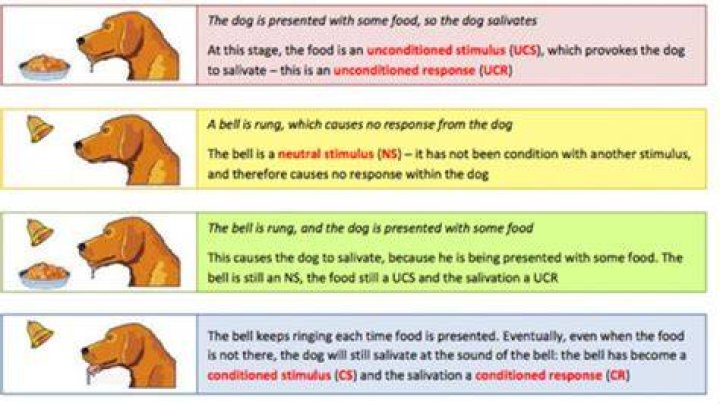
When the dog salivates to the sound of the bell the bell is the?
 Ava Bailey
 .
Keeping this in consideration, what is Pavlov's theory?
Pavlovian theory is a learning procedure that involves pairing a stimulus with a conditioned response. In the famous experiments that Ivan Pavlov conducted with his dogs, Pavlov found that objects or events could trigger a conditioned response. The result of the experiment was a new conditioned response in the dogs.
did Pavlov use a bell? Pavlov didn't use a bell, and for his real scientific purposes, couldn't. English-speakers think he did because of a mistranslation of the Russian word for zvonok (buzzer) and because the behaviorists interpreted Pavlov in their own image for people in the U.S. and much of the West.
Keeping this in consideration, what is the bell in Pavlov's classical conditioning?
Pavlov said the dogs were demonstrating classical conditioning. He summed it up like this: there's a neutral stimulus (the bell), which by itself will not produce a response, like salivation. There's also a non-neutral or unconditioned stimulus (the food), which will produce an unconditioned response (salivation).
What are the 3 stages of classical conditioning?
The three stages of classical conditioning include: Before Conditioning, During Conditioning, and After Conditioning.
Related Question Answers
Who is the father of operant conditioning?
Skinner
What are the 4 learning theories?
While expanding our knowledge of broad theories as a central focus continues to diminish, present-day researchers typically embrace one or more of four foundational learning-theory domains: behaviorist theories, cognitive theories, constructivist theories, and motivation/humanist theories.What is the Pavlov effect?
In Pavlov's experiments the unconditioned stimulus (US) was the dog food because its effects did not depend on previous experience. After conditioning, the metronome's sound becomes the conditioned stimulus (CS) or conditional stimulus; because its effects depend on its association with food.What is a conditioned response?
Conditioned Response (CR) In classical conditioning, the conditioned response (CR) is the learned response (reflexive behavior) to a conditioned stimulus (CS). For example, a dog salivates (UR) from the smell of a bone (US) naturally, without any conditioning.What is Skinner's theory?
B. F. Skinner was one of the most influential of American psychologists. A behaviorist, he developed the theory of operant conditioning -- the idea that behavior is determined by its consequences, be they reinforcements or punishments, which make it more or less likely that the behavior will occur again.What is a conditioned stimulus?
In classical conditioning, the conditioned stimulus is a previously neutral stimulus that, after becoming associated with the unconditioned stimulus, eventually comes to trigger a conditioned response.What is an example of classical conditioning in everyday life?
The influence of classical conditioning can be seen in responses such as phobias, disgust, nausea, anger, and sexual arousal. A familiar example is conditioned nausea, in which the sight or smell of a particular food causes nausea because it caused stomach upset in the past.What is unconditioned response?
In classical conditioning, an unconditioned response is an unlearned response that occurs naturally in reaction to the unconditioned stimulus. For example, if the smell of food is the unconditioned stimulus, the feeling of hunger in response to the smell of food is the unconditioned response.Who founded operant conditioning?
Skinner